08/17/2026 10
JLHY provides set screws for B2B buyers, distributors, importers, OEM purchasing teams and industrial manufacturers looking for a dependable fastener supply partner. Depending on the application and purchasing specification, set screws can be selected by thread size, length, material, point style, drive configuration, surface treatment and applicable standard.
Choose the Correct Set Screw Point Style
Flat point set screws provide a flat contact surface against the mating component. They can be suitable where the application requires positioning or clamping without an aggressively penetrating point.
For OEM purchasing teams, flat point set screws can be considered when the mating surface needs relatively broad contact and the application does not require a penetrating point.
Cone point set screws have a pointed contact geometry designed to provide concentrated contact against the mating surface.
They may be selected for applications where stronger location or holding at a defined point is required. The actual suitability depends on the shaft material, loading conditions, installation torque and application design.
Dog point set screws feature a projecting cylindrical tip. This configuration can be useful where the screw needs to locate into an existing hole, groove or other feature.
For machinery manufacturers and OEMs, dog point designs can provide a repeatable positioning solution when the mating component has been designed specifically for the projecting point.
Cup point set screws use a concave contact surface. They are widely associated with general-purpose shaft retention and positioning applications.
For high-volume fastener purchasing, cup point set screws are often considered when the application requires a commonly available set screw configuration with a defined contact geometry.
Set Screw Materials for Industrial Purchasing
Depending on the required specification, application environment and customer requirements, set screws may be manufactured from materials such as carbon steel, alloy steel or stainless steel.
Set screw Material selection can affect strength, hardness, corrosion resistance, machinability and overall service performance. For example, stainless steel may be preferred for applications where corrosion resistance is an important consideration, while hardened steel may be appropriate for applications requiring higher mechanical performance.
For B2B purchasing, the material should be specified together with the required mechanical properties and applicable standard. ISO notes that hardness classes and stainless steel grades can be selected from relevant fastener standards when required.
JLHY buyers should provide the required material specification, grade and application requirements when requesting a quotation so the manufacturer can quote the correct product rather than a visually similar alternative.
JLHY aims to support B2B buyers with set screw sourcing based on clearly defined product specifications and customer requirements. Whether the requirement is for standard set screws or an OEM/custom set screw, buyers can provide their technical requirements for evaluation and quotation.
Instead of requesting only a price, we recommend providing the size, thread, length, point style, material, surface treatment, standard and required quantity. More complete specifications allow the supplier to provide a more accurate quotation and help prevent specification differences during production.
Looking for a set screw manufacturer or OEM set screw supplier for your next purchasing project?
Send JLHY your:Size + Thread + Length + Point Style + Material + Quantity + Standard + Packaging Requirement
Our team can review your requirements and provide a quotation based on your specified product configuration. Contact JLHY today for OEM set screw sourcing, wholesale pricing and custom fastener requirements.
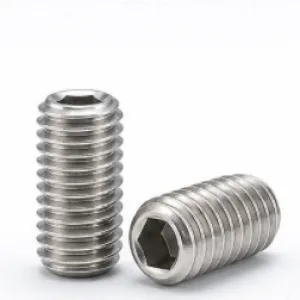
A set screw is a threaded fastener generally used to secure or position one component relative to another without requiring a conventional screw head. A common application is securing a component such as a hub, collar or gear to a shaft.
A set screw is commonly used to secure or position one component relative to another, often by applying pressure against a shaft, hub, collar or other mating component.
Common hexagon socket set screw configurations include flat point, truncated cone point, dog point and cup point designs. These configurations are covered by the current ISO 4026, ISO 4027, ISO 4028 and ISO 4029 standards.
A regular screw commonly has a head that remains accessible outside the assembly. A set screw is generally headless and is installed into a threaded hole to secure or position another component.
JLHY can evaluate OEM and custom set screw requirements based on the buyer's technical specifications. Buyers should provide drawings or detailed information about size, thread, length, point style, material, treatment, quantity and applicable standards.
Yes. Depending on manufacturing capability and order requirements, set screws can be specified with different dimensions, materials, thread configurations, point styles, finishes and packaging requirements.
For the most accurate quotation, provide the set screw size, thread pitch, length, point style, material, surface treatment, standard, quantity and packaging requirements. A technical drawing is preferred for non-standard products.
Current ISO standards include ISO 4026:2026 for flat point, ISO 4027:2026 for truncated cone point, ISO 4028:2026 for dog point and ISO 4029:2026 for cup point hexagon socket set screws. For more standards guide: DIN, ISO & ASME Socket Set Screws
Selection should be based on the application, mating components, required holding function, thread specification, material, point geometry, installation conditions and applicable engineering requirements. For critical applications, the final specification should be confirmed by the responsible engineer.
JLHY's B2B set screw offering is intended for buyers evaluating industrial fastener supply. Importers and distributors should provide their expected sizes, quantities, specifications and packaging requirements when requesting a quotation.