07/14/2026 21
When selecting stainless steel fasteners, one of the most common questions engineers, purchasing managers, and OEM manufacturers ask is:
Should I choose 304 or 316 stainless steel screws?
The answer depends on the operating environment, corrosion requirements, budget, and expected service life.
For most indoor and general industrial applications, 304 stainless steel screws provide excellent corrosion resistance and cost-effectiveness. However, 316 stainless steel screws are the preferred choice for marine, coastal, chemical, and highly corrosive environments because of their superior resistance to chlorides and aggressive chemicals.
Understanding the differences between these two materials helps buyers reduce maintenance costs, improve product reliability, and avoid premature fastener failure.
Quick Comparison: 304 vs 316 Stainless Steel Screws
| Feature | 304 Stainless Steel | 316 Stainless Steel |
|---|---|---|
| Chromium | ~18% | ~16–18% |
| Nickel | ~8% | ~10–14% |
| Molybdenum | No | Yes (2–3%) |
| Corrosion Resistance | Excellent | Superior |
| Chloride Resistance | Moderate | Excellent |
| Marine Applications | Limited | Highly Recommended |
| Chemical Resistance | Good | Excellent |
| Cost | Lower | Higher |
| Typical Grade | A2 | A4 |
The most important distinction between 304 and 316 stainless steel screws is corrosion resistance.
304 stainless steel performs very well in most indoor and outdoor environments. However, prolonged exposure to saltwater or chloride-rich conditions can eventually cause localized corrosion.
316 stainless steel is specifically designed to withstand these harsh environments. The addition of molybdenum enhances resistance to pitting and crevice corrosion, making it the preferred choice for marine and chemical applications.
If your products will be installed near the ocean or exposed to de-icing salts, 316 stainless steel is generally the safer long-term investment.
If your application involves saltwater, coastal environments, chemical exposure, or high humidity, choose 316 stainless steel screws. For most machinery, construction, furniture, and general industrial projects, 304 stainless steel screws offer the best balance between performance and cost.
When selecting between 304 and 316 stainless steel screws, consider the following questions:
If yes, choose 316 stainless steel.
Chemical exposure usually favors 316 stainless steel.
Choose 316 stainless steel.
304 stainless steel is usually sufficient.
304 stainless steel offers excellent value for most standard applications.
Selecting between 304 and 316 stainless steel is only one part of a successful sourcing strategy. Working with an experienced manufacturing partner ensures that the specified material is processed consistently and meets the required standards.
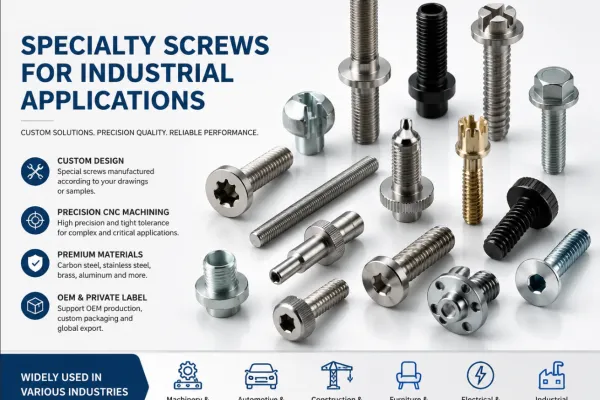
JLHY manufactures precision stainless steel screws using SUS304, SUS316, SUS201, SUS410, and other stainless steel grades for customers across industrial, construction, automotive, marine, renewable energy, and OEM sectors. Our manufacturing capabilities include:
Standard and custom stainless steel screws
OEM and private-label production
Precision cold heading and thread rolling
Support for DIN, ISO, ANSI, and JIS standards
Material certification upon request
Dimensional and thread inspection throughout production
Flexible manufacturing for both standard and custom specifications
By combining engineering expertise, quality control, and responsive customer support, JLHY helps buyers select the most appropriate stainless steel fasteners for their applications.
If you are uncertain whether 304 or 316 stainless steel screws are the better choice for your project, our engineering team can provide technical recommendations based on your operating environment, performance requirements, and budget.
Neither material is universally "better." 304 stainless steel is the preferred choice for most general industrial applications because it offers excellent corrosion resistance and value. 316 stainless steel is recommended for marine, coastal, and chemically aggressive environments due to its superior resistance to chlorides.
304 stainless steel has excellent corrosion resistance, but prolonged exposure to chlorides or harsh chemicals can lead to localized corrosion. Choosing the correct material for the application is essential.
For environments exposed to saltwater, chemicals, or frequent moisture, the improved corrosion resistance of 316 stainless steel often results in lower maintenance costs and a longer service life, making it a cost-effective long-term solution.
Look for a manufacturer like JLHY with proven experience, certified raw materials, precision manufacturing processes, comprehensive quality inspection, and the ability to provide technical support and OEM customization.